Before you fix anything, find out what’s actually wrong.
We trace how work, money, documents, and decisions move through your business, then tell you what’s broken, what it’s costing, and the order to fix it in. Nothing gets recommended until we know what has to happen first.

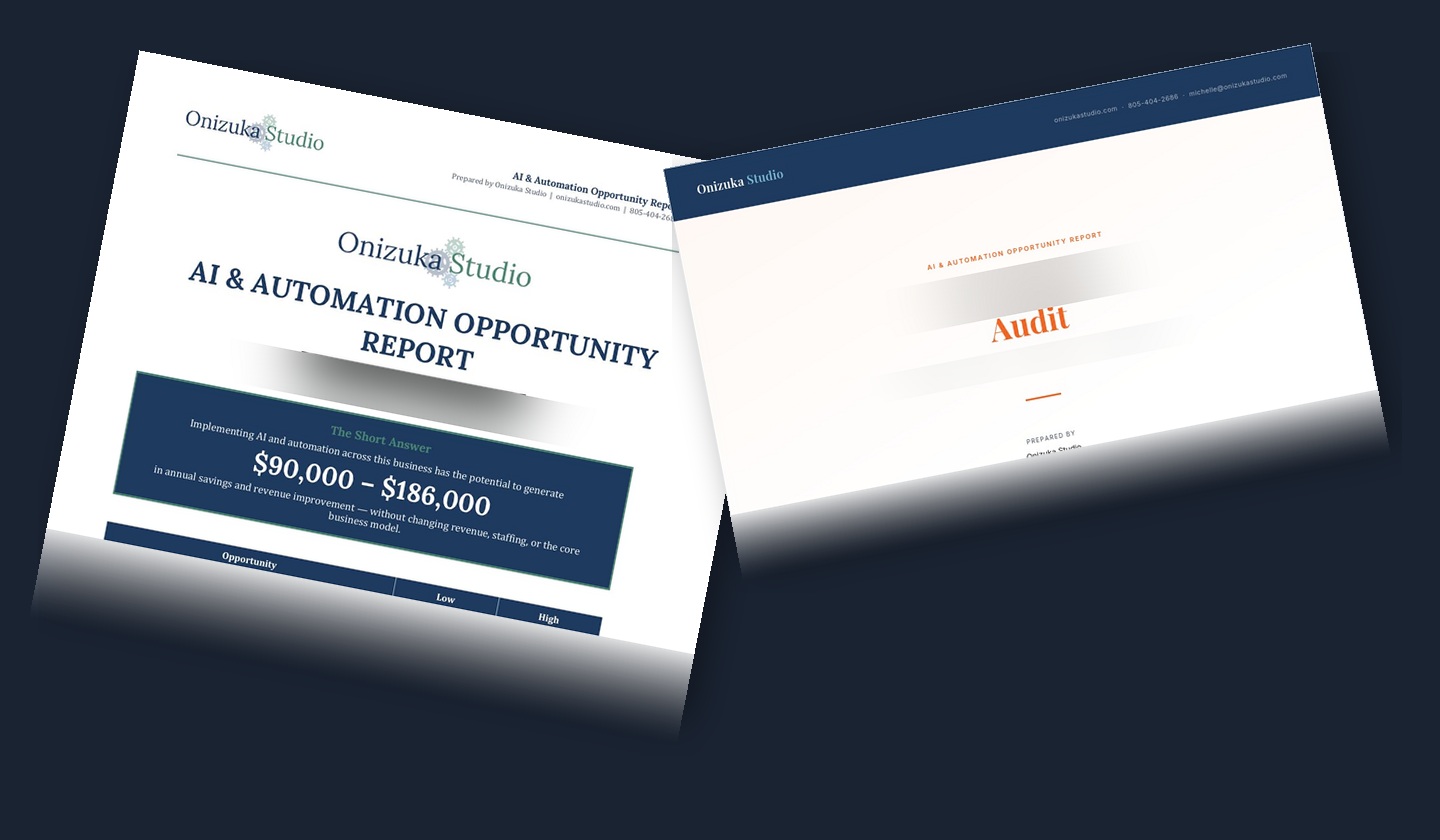
A report someone could build from.
Not a strategy deck and not a proposal in a discovery costume. It’s written so another qualified team could pick it up and work from it, which is the only real test of whether a diagnosis was any good.
- 01What’s wrong
Every finding traced back to something specific about how your business runs. No generic industry advice.
- 02What it takes
What the current way costs you in time where we can estimate it, what the fix takes, and who can do it. So you can tell the difference between annoying and expensive.
- 03What order
Phases, with dependencies. Some things break if you do them before the thing they sit on. That’s the part nobody else gives you.
- 04Who does it
You, your team, one free call with a vendor you already pay, or a developer. Most of it isn’t work you need to hire for.
- 05What not to touch
What would get worse if you automated it, and what’s already working fine and should be left alone.
Automating the wrong process only makes the wrong process run faster.
You’ve heard of automation audits and AI readiness assessments. Most start with the technology and end by recommending more of it.
The order is the product
Ask AI what to automate and you get twenty ideas in no order. Some break if you do them before the thing they sit on. One or two shouldn’t be done at all.
We look at the seams
Almost nothing breaks inside billing or inventory. It breaks in the handoff between them, and that gap belongs to no vendor.
Diagnosed by the builders
Two systems architects covering both layers, the software people touch and the infrastructure underneath. Nothing gets recommended that can’t actually be built.
You tell us how your business runs. We mold the tech around it.
That sequencing claim is the whole argument, so we made it something you can test.Play through three real workflows →
Which one are you?
The method doesn’t change. What changes is whether you’re the one who’d use it or the one who’d recommend it.
I want it to work better
You’re not selling. The operation is heavier than it should be, and every attempt to fix it has added a step somewhere else.
- “We’re doing the same work in three systems.”
- “It only works because I’m watching it.”
- “We tried automating it and it made more work.”
I’d refer this to a client
Brokers, CPAs, attorneys, fractional CFOs. You’re not buying it, you’re deciding whether to put your name on it.
- “Would this make my buyer’s diligence better?”
- “Can I hand a seller something useful?”
- “What does it do to my timeline?”
Buying or selling a business instead? That’s the same exam aimed at a different question →
Same method, different vocabulary.
An industry here is a set of operating conditions rather than a trade, and those conditions change what we ask you.
Trades
Dispatch, estimate to invoice, licences, recurring service, and crews who are never at a desk.
Service businesses
You sell time and expertise. Every hour that goes to admin is an hour nobody paid for.
Churches & nonprofits
Volunteers, restricted funds, recurring giving, facilities, and a staff smaller than the work.
Every price we charge is on one page. See pricing →
Start with your industry and see what comes back.
Nine questions, no email, no sales call. You get a real sequenced plan, not a score. If you’re an owner it’s your own business. If you’d be referring this, run it on a client’s industry and see exactly what you’d be handing them.
Takes about three minutes. Nothing to install, nothing to schedule.
Before you decide.
What is a business systems audit?
A business systems audit traces how work, money, documents, and decisions actually move through a business, then reports what is broken, what each problem costs, and the order the fixes have to happen in.
How much does a business audit cost?
Onizuka Studio offers a free industry scan, a $995 self-service Operations Audit with $500 credited toward further work, and a human-led Business Systems Audit at $4,500. Acquisition-related audits run $2,500 to $7,500.
Why does the order of automation matter?
Most automation projects fail because the pieces were built in the wrong sequence rather than because the wrong tools were chosen. Automating a process that sits on unreliable data produces wrong results faster.
Can I just ask AI what to automate in my business?
AI will return a list of reasonable ideas with no dependencies between them. It cannot tell you which item has to come first for your specific systems, which items break if done early, or which should not be automated at all.
Do I have to hire you to implement the findings?
No. The report is written so another qualified team could build from it. Roughly two thirds of a typical report is work that does not require hiring anyone.